The Full Guide — Crepe Myrtle Care, Start to Finish.
The whole method in one place: what those shoots are, how to walk the tree each month, what form to grow, where the cut goes, how to bring a topped tree back, and what to do in every month of the Lafayette year.
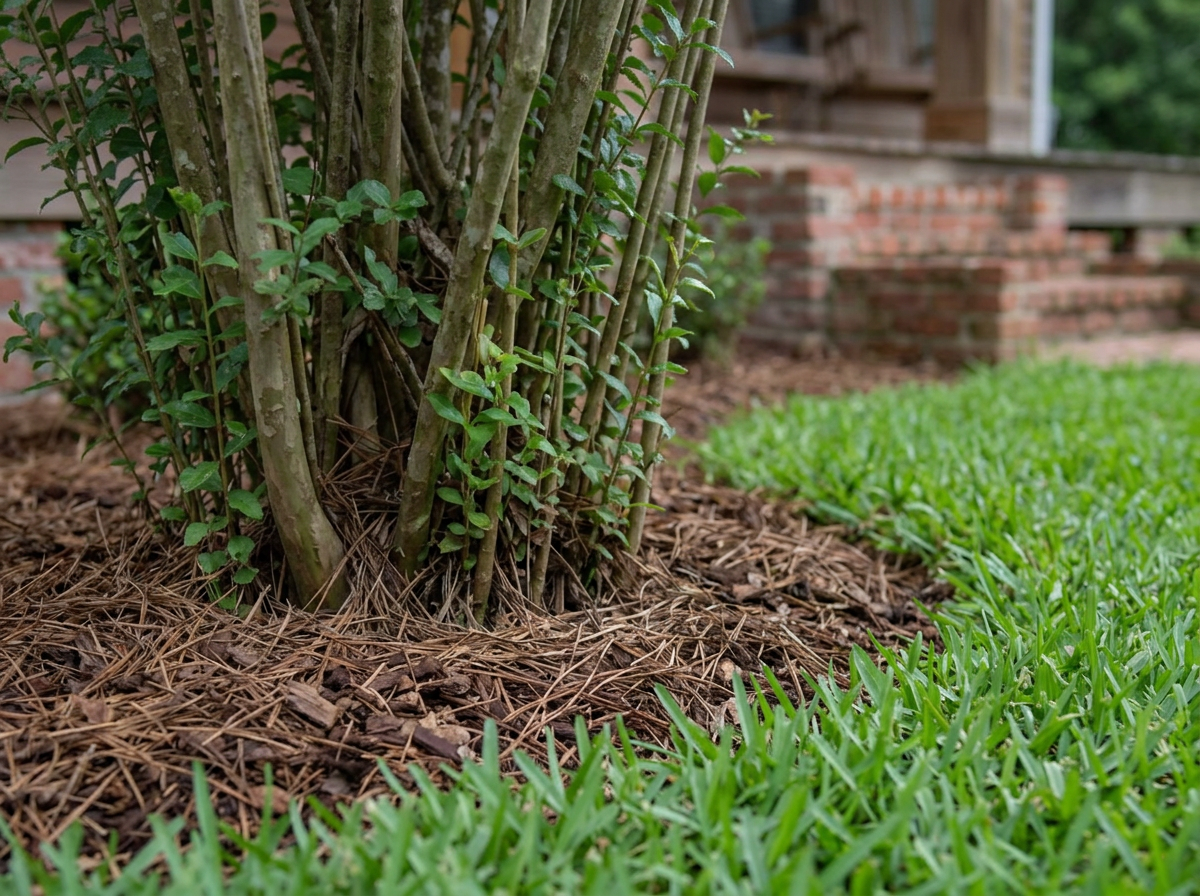
Tap a point on the photo. Every one of those green whips is competing with the trunks you paid for.
Basal sproutsShoots erupting from the root crown right where trunk meets soil. These are the ones that close in around the base and erase the trunk line. They're also the easiest to catch early.
Root suckers
Shoots coming straight out of the ground, sometimes a foot or more away from the trunk, rising from the root system. The most persistent kind. Good news: crepe myrtles are almost always grown on their own roots, so a sucker is the same variety as the tree — it's not a rootstock takeover. It's still stealing water, light, and energy from the trunks you actually want.
Basal sprouts
Shoots erupting from the root crown right where trunk meets soil. These are the ones that close in around the base and erase the trunk line. They're also the easiest to catch early.
Water sprouts
Thin, unnaturally vertical shoots coming off the trunks and main limbs higher up, often in a row. They shoot straight up instead of following the branch structure, and they're always weakly attached.
Why it’s happening
Stress
drought, soggy roots, or a hard summer
Injury
the single biggest trigger in Lafayette: string trimmer and mower damage at the base of the trunk
Overfeeding
too much nitrogen lawn fertilizer running into the root zone
Heavy pruning
the more you cut off the top, the harder it pushes from the bottom
Planted too deep
the root flare should be visible at the soil surface
The entire maintenance program
Five minutes, once a month, April through September.
This is not a pruning job. It’s a walk around the yard with your hands. Done on schedule, it takes almost no time and your tree never gets away from you. Skipped for a season, it becomes an afternoon with loppers.
01
Catch them green
A sucker under about six inches is soft, green, and not yet woody. Grab it low and rub or snap it off sideways where it emerges. Tearing it out green takes the dormant buds with it, so it comes back slower than if you'd cut it cleanly. This is the single most efficient minute you will spend on this tree all year.
02
Cut the woody ones flush
Anything that's hardened off needs bypass hand pruners. Cut it flush at its point of origin, right where it swells out of the trunk or root. Leave no stub. A stub is a launchpad — cut one sucker halfway and you get three next month.
03
Go below the soil line
For shoots coming out of the ground away from the trunk, scrape back an inch of soil, remove the sucker where it attaches to the root, then re-cover. Snapping it off at ground level leaves the base behind and it will be back in three weeks.
04
Stop hitting the trunk
Every string trimmer nick and mower bump at the base tells the tree it's under attack, and it answers with sprouts. Put a mulch ring two to three feet wide and two to three inches deep around the trunk and never bring a machine inside it. Keep the mulch pulled back a few inches from the bark — do not pile it up against the trunk.
05
Put it on the calendar
Walk the tree on the first weekend of every month from April through September. That's six walks a year. That is genuinely the whole job.
The counterintuitive part
The harder you prune a crepe myrtle, the more aggressively it suckers. Restraint up top means less work down below.
Decide what you’re growing
Every crepe myrtle is either one trunk or several. Pick one and commit.
Almost all the confusion about pruning these trees comes from never having decided what shape you’re aiming at. Both forms are correct and beautiful. What doesn’t work is drifting between them — which is what happens when you remove some suckers, keep others, and let the tree vote. Choose, then maintain the choice.
3–5 trunks
Clear to 4–6 ft
Canopy above
Best for
Open lawns, corner plantings, anywhere you want a sculptural silhouette. This is the form that shows off the most bark, and bark is the reason to grow this tree.
Establishing it (years 1–3)
In late winter of the second year, look at everything coming out of the ground and choose three to five stems to keep. Odd numbers look better than even. Take the strongest, best-spaced ones that lean gently outward — you're building a vase, not a bundle.
Remove every other stem at ground level, flush, no stubs.
Tie a ribbon of flagging tape on your keepers so you don't second-guess yourself next winter. This sounds silly. Do it anyway.
Do not limb up yet. The lower branches are feeding trunk thickness. Leave them until the trunks are an inch and a half to two inches across.
Maintaining it (forever)
Sucker patrol. Anything coming from the ground that isn't one of your chosen trunks comes out, every time you see it. This is 90% of the job.
Each late winter, remove the lowest tier of side branches from each trunk, working gradually upward over several years until you have clear trunk to roughly four to six feet. Stop when you can comfortably walk under it. Clear trunk should never exceed about half the tree's total height.
Thin the canopy: take out branches that cross, rub, or grow back into the center. You're opening the middle so air moves through, which is how you cut down powdery mildew in a humid Louisiana summer.
Never remove more than about a quarter of the canopy in one year.
Keep your trunk count. The one exception: if a trunk is damaged or lost, let a single well-placed sucker grow up to replace it. That's the only time a sucker is your friend.
Either way, the cuts happen in late winter — January or February in Lafayette — while the tree is bare and you can actually see what you’re doing. Sucker removal is the exception: do that whenever you see one, all year long.
The only cut you need to get right
Where to cut.
Right
Cut just outside the branch collar, the slightly swollen ring at the base of the branch. The collar contains the tissue the tree uses to seal the wound.
Wrong
A flush cut slicing into the trunk, removing the collar. Slow to seal, opens the trunk to decay.
Also wrong
A stub left behind. Can't seal at all, dies back, and sprouts a cluster of new shoots.
For small twigs, cut just above an outward-facing bud. For anything larger, find the collar and cut just outside it. And the rule that settles most arguments: if the cut needs a chainsaw, a pole saw, or a ladder, it’s the wrong cut. Hand pruners and occasional loppers are the correct tools for this tree.
The felony
Crepe murder. We have to talk about it.
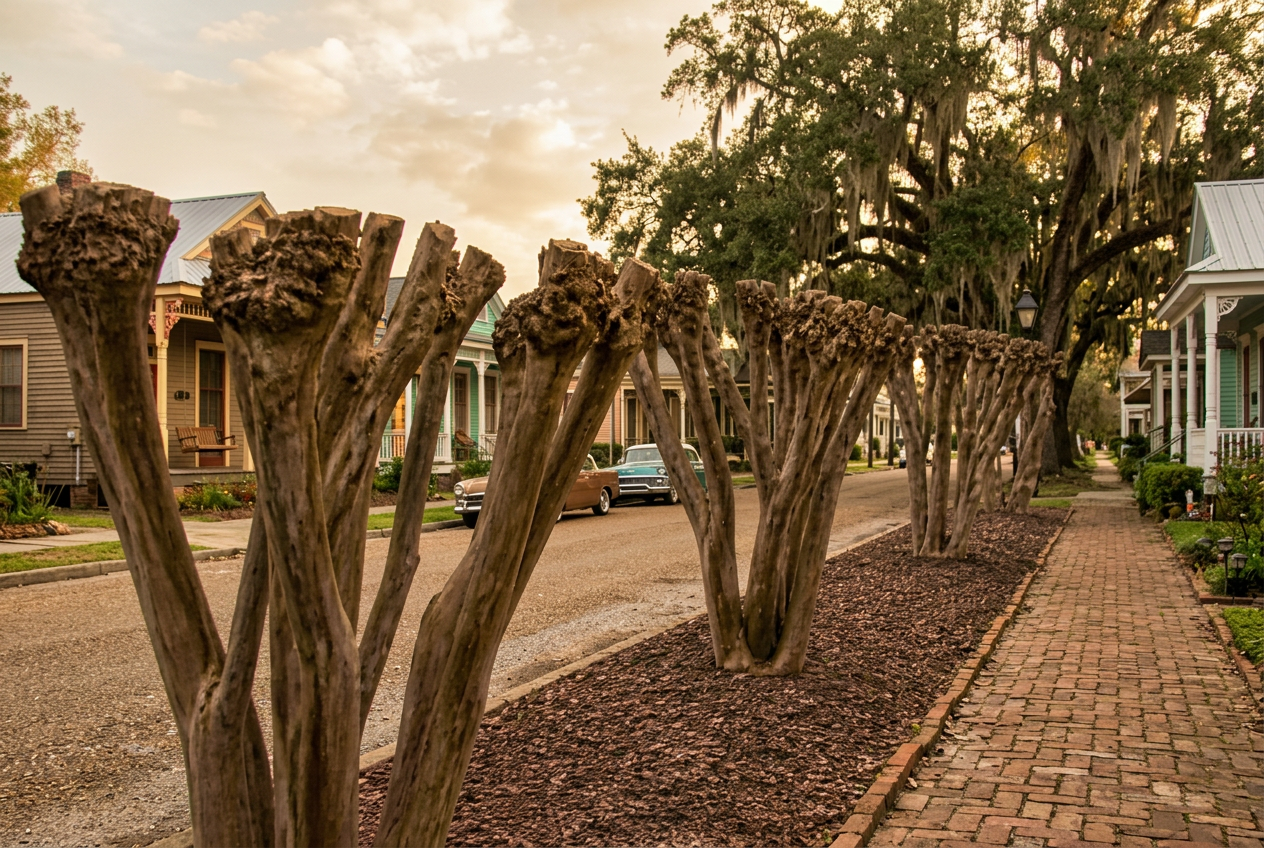
Every February, crews across Lafayette saw crepe myrtles off at the same height until the trunks end in swollen fists. It is the most common thing done to this tree, and the worst.
Forty trees. One decision. Repeated every winter.
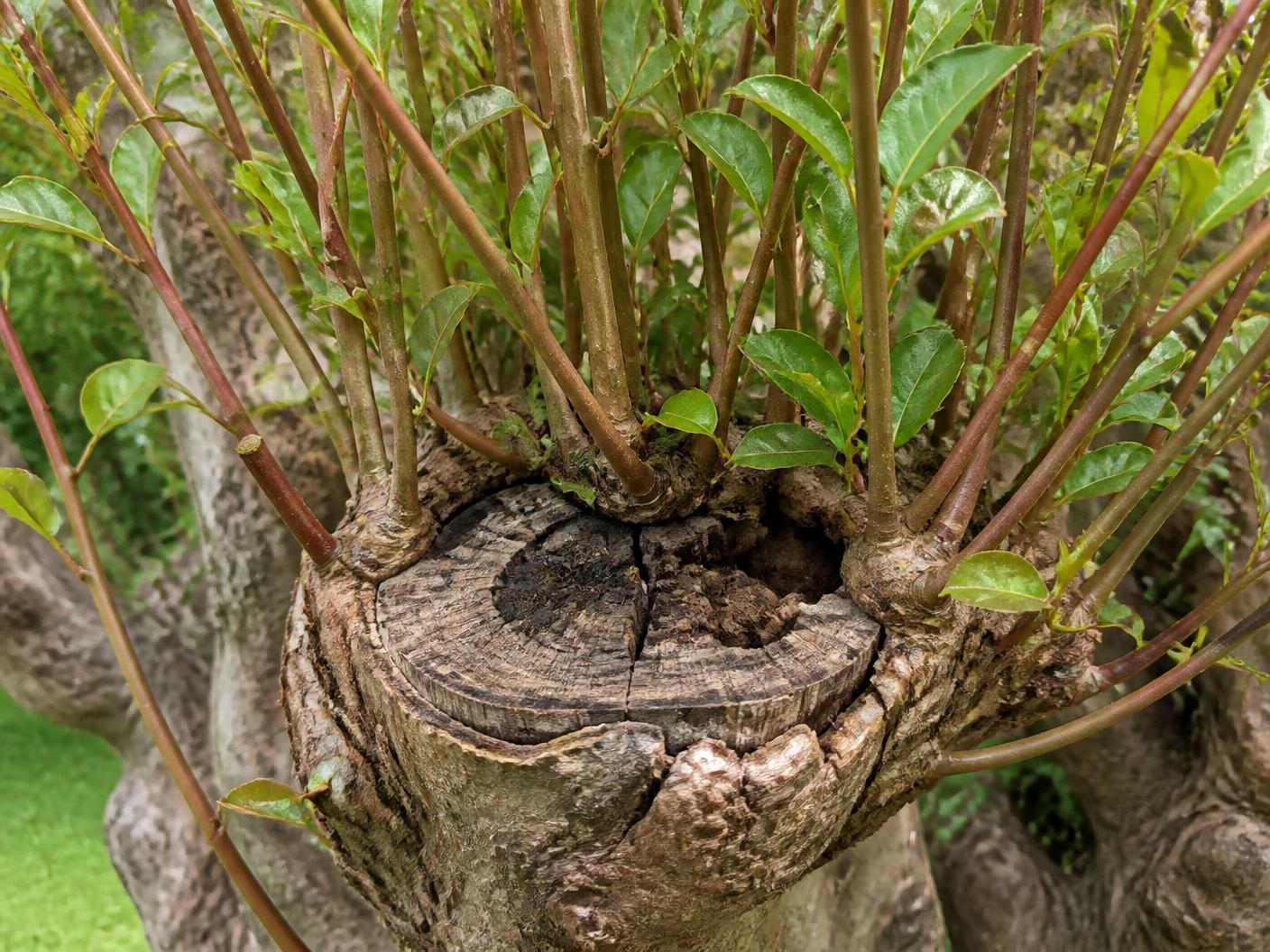
June, same tree. The cut couldn’t seal, so the tree threw a fistful of whips at it.
Let’s cut the crap
Four things people say about topping.
“It makes it bloom more.”
It blooms later, on shoots too thin to hold a flower head up in a July storm. Bloom count goes down, droop goes up.
“It keeps it small.”
The tree answers a hard cut with up to six feet of fast, weak growth. You are not controlling size; you are subscribing to a chore.
“Everybody does it.”
Everybody does it because everybody saw it done. It arrived as a habit, not horticulture — and habits are breakable.
“The tree survives it.”
Survival is a low bar. Flat cuts that big can't seal, so decay walks straight into the trunk and the knuckles get heavier every year.
And here’s the tie-in: topping is a sucker factory. Cut a crepe myrtle back hard and it answers from every point it can, top and bottom — the shapeless lumps around town are almost always trees that got topped and then abandoned.
It is reversible.
Nobody on this campaign is interested in shaming a tree owner. Step through the years: this is three growing seasons of restraint, not a replanting budget.
Year 1 — Stop topping
Let it sprout. The following late winter, look at the thicket on each knuckle and keep only the one to three strongest, best-angled shoots. Remove the rest flush.
Rebuild it
3 years
Stop topping. Next late winter, look at the thicket on each knuckle and keep only the one to three strongest, best-angled sprouts. Remove the rest flush. The following year, thin those keepers like normal branches. By year three the canopy has closed over the knuckles and you're back to ordinary maintenance.
Start over
2 to 4 years
For a tree that's hopelessly disfigured, cut every trunk off at ground level in late winter. The established root system will send up a forest of shoots that spring. Let them run one season, then select three to five to become your new trunks and remove everything else at the ground. You get a properly structured young tree with clean bark in about the time it takes to regret topping it again.
Zone 9a, month by month
Can I prune today in Lafayette Parish?
Today · September 30, 2026
No.
Structural pruning is out of season. Suckers, though, come off whenever you see them — all year long.
September
Last sucker patrol of the year
No structural pruning; late cuts push soft growth that won't harden before the first cold snap.